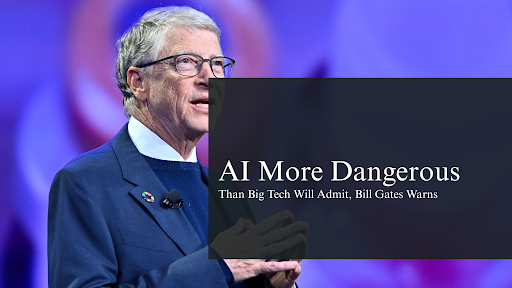
Microsoft co-founder Bill Gates is issuing one of his strongest warnings yet about the rapid advancement of artificial intelligence, arguing that governments and society are not adequately prepared for the economic and social disruption that could follow.
In an interview with The New York Times, Gates said recent advances in AI have significantly exceeded his expectations and warned that the technology poses serious risks to employment, cybersecurity, public safety and the broader economy. He believes addressing those risks should become a major global priority.
Perhaps most concerning is the speed at which the transformation is occurring. AI capabilities are advancing faster than governments and society are preparing for their consequences, while there is currently no coordinated plan for navigating the transition. Gates has described the coming shift as potentially one of the most turbulent periods in modern history.
A Growing Threat to the Labor Market
One of Gates’ primary concerns is widespread job displacement. Unlike previous technological revolutions, which eventually created new categories of employment, AI has the ability to replace aspects of human cognition itself.
Gates warns that many jobs could disappear permanently, with entry- and mid-level positions particularly vulnerable. The disruption could extend across both white-collar and blue-collar industries, affecting fields ranging from customer service and law to medicine, software development and manufacturing.
The consequences could extend far beyond unemployment. A rapid decline in traditional employment could place additional pressure on government revenues, social programs and communities at the same time that displaced workers require greater assistance and retraining.
Governments Are Not Prepared
Gates argues that today's institutions were simply not designed to manage a technology capable of transforming so many areas of society simultaneously.
AI could affect employment, taxation, national security, energy, elections, public health, financial systems, education and critical infrastructure. Yet Gates believes governments currently lack the coordinated national and international framework necessary to manage those risks.
He has proposed measures including new institutions dedicated to AI oversight, international agreements addressing extreme AI risks, protections that would reserve certain jobs for humans and potentially taxing AI usage to help fund assistance for workers displaced by automation.
Gates has also criticized the idea that technology companies should be responsible for policing themselves, arguing that market incentives may not always align with what is best for society.
Preparing for a Period of Uncertainty
Gates remains optimistic about AI's potential to improve medicine, education, government services and productivity. But his message is increasingly urgent: those benefits are not guaranteed, and the world needs to prepare for significant disruption as the technology advances.
For individuals and families, warnings about technological disruption, employment uncertainty and broader economic change are another reminder of the importance of considering resilience and diversification when preparing for an unpredictable future.
Physical precious metals have historically been viewed by some as one component of a diversified approach during periods of economic and financial uncertainty. As technology reshapes the global economy at an unprecedented pace, conversations about protecting purchasing power, diversifying assets and preparing for unexpected disruption are likely to remain increasingly relevant.
Source: The New York Times, “Bill Gates Warns A.I. Is More Dangerous Than Big Tech Will Admit,”
Red State Gold Group is a precious metals dealer and does not provide financial, tax, or investment advice.