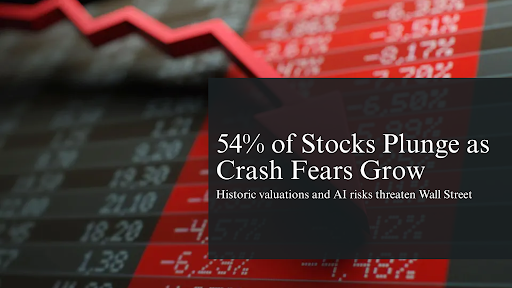
Despite major stock market indexes remaining near record highs, a growing number of U.S. companies are experiencing significant losses, raising concerns that Wall Street's apparent strength may be masking deeper financial instability.
According to Morgan Stanley data highlighted in a recent Forbes report, more than 54% of stocks in the Russell 3000 index have declined at least 20% from their June highs, a drop commonly associated with bear market territory. Nearly 90% have fallen more than 10%, while approximately 29% have lost over 30% of their value.
The disconnect is largely driven by a handful of major technology companies whose enormous market capitalizations continue to support indexes like the S&P 500, even as much of the broader market struggles. This concentration raises concerns that a downturn among these market leaders could expose the underlying weakness that headline indexes have largely concealed.
Adding to these concerns, stock market valuations are approaching historic extremes. The Shiller CAPE ratio, a widely followed measure of long-term stock valuations, has climbed toward levels last seen during the dot-com bubble. Such elevated valuations leave investors increasingly vulnerable if corporate earnings fail to meet expectations or economic conditions deteriorate.
Artificial intelligence has emerged as both a major driver of market optimism and a potential source of instability. Technology companies are committing enormous amounts of capital to AI infrastructure, with current valuations dependent on expectations of exceptional future profitability. If those returns fail to materialize, investors could begin reassessing the prices they are willing to pay for some of the market's largest companies.
Meanwhile, persistent inflation and elevated interest rates are creating additional challenges. Higher borrowing costs can pressure corporate earnings, reduce business investment, and make expensive stock valuations increasingly difficult to justify.
Prominent investors are also taking different approaches to these risks. Michael Burry has expressed skepticism toward portions of the AI boom, Warren Buffett's long-standing investment philosophy emphasizes valuation discipline, and Bill Ackman has highlighted opportunities that can emerge during periods of market turmoil.
Perhaps the greatest concern is the possibility of a chain reaction across financial markets. Falling stock prices can weaken investor confidence, tighter financial conditions can pressure corporate earnings, and concentrated selling can accelerate further declines. Similar reinforcing pressures have contributed to some of Wall Street's most severe historical downturns.
The central question is whether the majority of struggling stocks will recover or whether the small group of highly valued companies supporting the major indexes will eventually face the same downward pressure.
For Americans approaching retirement or focused on preserving their long-term savings, these developments highlight the risks of market concentration and the importance of diversification. With valuations stretched, inflation concerns persisting, and uncertainty surrounding the AI boom, physical gold and silver may be worth evaluating as part of a broader long-term wealth preservation strategy.
Red State Gold Group sells physical precious metals. This content is for informational purposes only and should not be considered financial advice.